
Comments on IBX Draft Scoping Document
John B. Pegram[1]
The MTA has requested comments on its Draft Scoping Document for the proposed Interborough Express (IBX) line. Although there will be no more scoping hearings at which members of the public can make oral comments about the Draft Scoping Document, the MTA’s IBX website explains how written comments can be submitted until the November 26, 2025 deadline.
I am sending a copy of this article to the MTA as my comments on IBX Frequency, Connections, Stations, Mode and Choice of Railcars, Traction Power, Operations Facility and Storage Yard, and Transparency.
A PDF copy of this article is attached here:

A. FREQUENCY
Comment 1. IBX Trains should be frequent at off-peak hours as well as at peak times. One of the two greatest concerns of potential IBX riders is frequency of trains. Train frequency is important because the IBX will be only one of two or three transit lines that most riders will use for each trip and IBX train frequency will affect the the ability to make good connections and total trip time.
Waiting, especially outside in hot or cold, windy, rainy or snowy weather, is uncomfortable and makes transit unattractive. Ask me or other Brooklynites about how they feel about waiting 20 minutes, outside, at night for a train. If IBX trains come every 2-5 minutes, like the #1 Metro line in Paris, the IBX will be much more attractive. That can be easily accomplished by fully automatic operation of the IBX railcars. See Comment 20 below.
Frequent off-peak service is particularly important because New York is a 24-hour city and many potential IBX riders work on schedules other than that of classic 9-5 office jobs. The fact that such persons often drive to work, because of lack of practical, speedy transit alternatives, were revealed in the Congestion Pricing discussions.
The headways between trains under current NYC Transit guidelines[2] are based on base “Policy Headways” of 10 to 20 minutes between trains at different days and times, with the headways reduced (increasing frequency of trains) only when that has been predicted to be necessary to avoid overloading trains. Five to ten car subway trains are rarely overloaded on most NYC subway lines during the later “Evening” and overnight “Midnight” hours, between 10 pm and 5 am. Therefore, the frequency is rarely increased on those lines at those times. On the IBX line, frequency should be based on convenience for riders, and not based on whether the trains are full.
Comment 2. The frequency of IBX trains should be reevaluated in light of the almost doubling of the MTA’s ridership predictions since January 2023 and even higher third-party predictions.
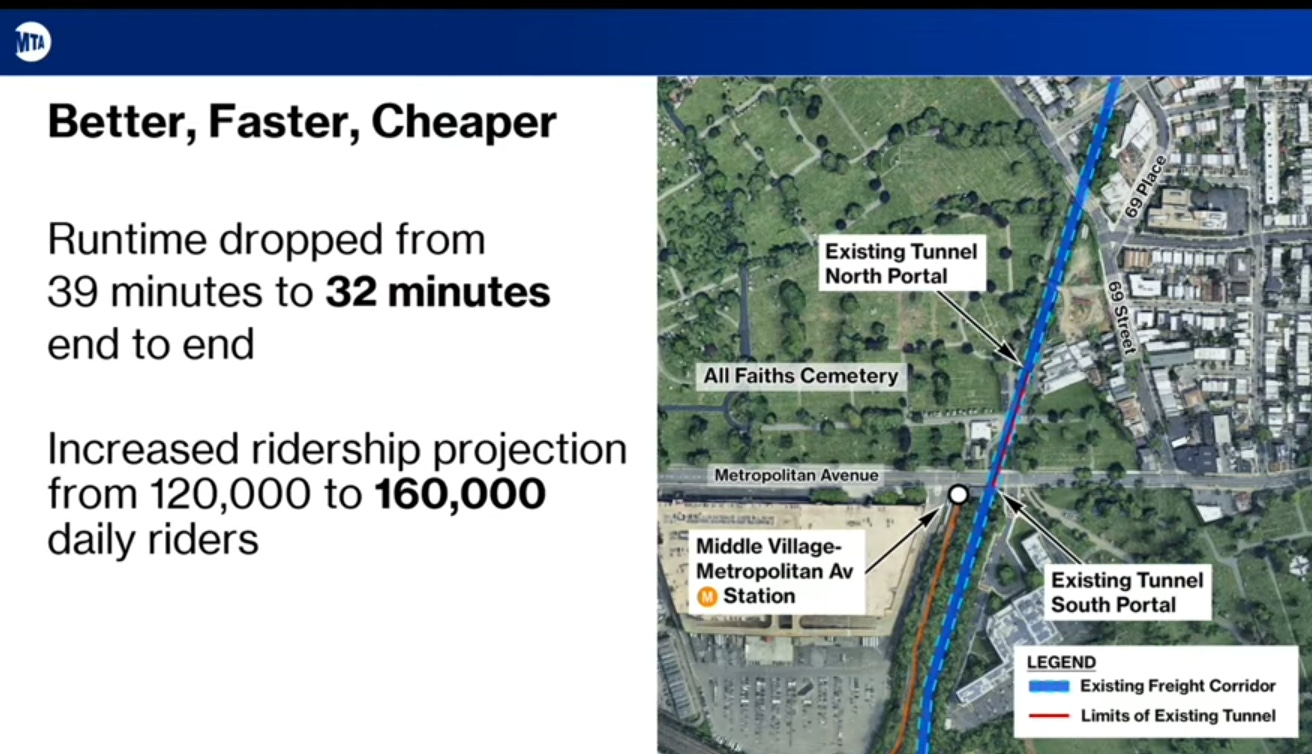
The January 2023 Feasibility Study Interim Report[3] predicted an IBX weekday LRT ridership of 87,800. The Planning & Environmental Linkages Study report (PEL Report) in January 2024[4] estimated IBX weekday ridership in the LRT mode would be 115,000. In August 2025, Governor Hochul reported an IBX weekday ridership prediction of 160,000,[5] which was also included on a slide (reproduced below) in a September 29, 2025 presentation to the MTA Board Capital Programs Committee.[6] Others, outside the MTA, have predicted an IBX weekday ridership as high as 254,000 trips. See Pegram, Interborough Express Ridership Predictions—Part 1 and Interborough Express Ridership Predictions—Part 2.
In January 2023, the IBX Feasibility Study Interim Report Appendix 1.16 stated “Originally two-car LRVs were envisioned. However, due to strong ridership projections, this was increased to three-car LRVs trainsets.”[7] Therefore, under the present ridership predictions, such trains would have to be either twice as long (requiring longer station platforms) or twice as frequent to handle the predicted volume at peak times.
B. CONNECTIONS
Comment 3. Connections to bus and subway lines should be improved over most recently disclosed IBX plans. The other most frequent concerns I have heard about the IBX proposal are about connection times and out-of-system walking for connections with bus and subway lines,. The Governor, MTA and its consultants have correctly recognized the importance of running time between IBX stations, bragging recently about a predicted reduction in end-to-end running time from 39 to 32 minutes.[8] More attention should be given to overall trip time for IBX riders, as affected by connections and frequency of IBX trains.
Comment 4. A weather-protected corridor and escalators should be provided between the IBX station in Jackson Heights, Queens and the Roosevelt Avenue-Jackson Heights subway stations. Jackson Heights would be one of the busiest on the Interborough Express (IBX) line, especially because of transfers. However, the proposed IBX transfers there would be out-of-system and take about 5 minutes or more. (Compare that with 10 seconds for a cross-platform transfer.) Many comments have expressed a preference for an off-street connection at this station. See Pegram, Interborough Express Transfers in Jackson Heights.
Comment 5. An IBX – LIRR Woodside connection should not be suggested in the final Scoping Document or IBX literature. The Draft Scoping Document states, at page 2 that the Jackson Heights–Roosevelt Avenue/74th Street subway station “would be within walking distance of the Woodside LIRR station….” In fact, the stations would be about 2,250 feet or nine blocks apart; probably at least 14 minutes walking time between station platforms, including delays crossing streets. The Woodside LIRR station is too far from the Jackson Heights IBX station for a reasonable connection and, therefore, should not be promoted as such. If such a connection is mentioned in the final Scoping Document or Environmental Impact Statement (EIS) or other IBX materials, the walking time should be indicated and justified.
Comment 6. An underground passage way, escalators and elevators should be provided to connect between the currently named Atlantic Avenue station on the IBX line and the Broadway Junction subway station. The MTA’s reports indicate that this station will be one of the most used on the IBX line.[9] Usage predictions are likely to more than double now that the MTA plans have moved this IBX station closer to the Broadway Junction subway station and in view of increased ridership predictions. See Comment 15 below re station name. See Pegram, There Should Be a Broadway Junction Station on the Interborough Express & An Atlantic Avenue Entrance to the IBX Broadway Junction Station.
Comment 7. A cross-platform connection should be provided between the IBX line and the Sea Beach subway line at 8th Avenue or, if that proves impractical, escalators be provided at between the stations on those lines at 8th Avenue. Published IBX plans do not include a good subway connection at 4th Avenue. The entrance to the so-called Fourth Avenue IBX station (see Comment 16 re station name) would be at 5th Avenue, approximately 2,100 feet walking distance from the nearest stops on the 4th Avenue subway line. That is too far—in my opinion—for a reasonable connection. For that reason, the ability to transfer between IBX and N trains at the Eighth Avenue station should be optimized. Riders could change at 8th Avenue when travelling to or from downtown Brooklyn or lower Manhattan on the “N” train. Riders going to or from local stations in either direction on 4th Avenue could transfer between the “N” train and the “R” train in the 59th Street subway station.
Comment 8. Transfers between the IBX line and the 4th Avenue line at the IBX “4th Avenue station should not be suggested, because they are too far apart. The currently planned location of the “4th Avenue” IBX station entrance is on 5th Avenue. See Comment 16. That is approximately 2,100 feet from either the Bay Ridge Avenue station (“R” train) or 59th Street station (“N,” “R” & “W” trains), both of which are on 4th Avenue). That is too far—in my opinion—for a reasonable connection and it should not be promoted as such. If such a connection is mentioned in the Scoping Document or EIS, the walking time should be indicated and justified.
A IBX station entrance on 5th Avenue, however, would be a convenient location for transfer to and from the B63 bus, which provides service—mostly along 5th Avenue—between downtown Brooklyn and 95th Street in Bay Ridge.
C. STATIONS
Comment 9. The designs of most stations should be standardized and the same contractors engaged to build all stations of the same type, one-after-another, for greater efficiency.
Comment 10. Stations should be of the high-platform type. This is desirable for the railcar reasons discussed in Comment 21.
In addition, a majority of the IBX stations will be in a cut, therefore, there would be less steps to climb to street level from a high platform than from a low platform. Also, waiting riders are more likely to step onto the tracks from a low platform without platform screen doors (as I have seen on the NJ Transit Hudson-Bergen Light Rail line and Paris trams), requiring trains to slow before entering stations instead of entering stations at speed, as on NYC Transit subways. That would adversely affect runtime.
The possibility of flooding of low platforms in a cut should also be considered.
Comment 11. Completely enclosed and climate-controlled stations, with platform screen doors, should be considered. Stations should provide better shelter than current outdoor subway stations, which are essentially100+ year-old designs. The MTA artists’ pictures of IBX stations are lovely, showing lightly dressed people on a bright, sunny day. But, more than 30% of the days in New York City are grey, windy, and have rain or snow. Fully enclosed stations also would protect riders from the dust and noise from freight trains on the adjoining tracks. Note that the new Montreal Réseau express métropolitain (REM) line has fully enclosed and climate-controlled stations. See Wikipedia, Réseau express métropolitain. The IBX line should too. See Pegram, “Amenities” at Interborough Express Stations.
Comment 12. If stations are not fully enclosed, they should at least have a roof covering the entire station and should have heated platforms, to aid in snow and ice removal. The PEL Study Report Appendix 1.11, for example at page 11 [823/1150], indicates that Platform Snow Melt Systems were planned for the Conventional Rail mode, but not for the Light Rail mode. (A cynic might say that was done as part of an effort to make Light Rail appear more cost effective). Regardless of the mode and regardless of the reason for previously omitting heated platforms in Light Rail mode cost estimates, heated platforms should be provided in the final design at any stations that are not fully enclosed.
Comment 13. Platform screen doors should be considered in design of all IBX stations. See, Pegram, Platform Screen Doors and the Interborough Express.
Comment 14. All major stations should include escalators, which would expedite transfers. Even if omission of escalators was justified with the earlier IBX ridership predictions, current ridership predictions make consideration of escalators at major IBX stations necessary.
Comment 15. The currently named “Atlantic Avenue” IBX station should be renamed as the “Broadway Junction” station. The majority of riders using that IBX station will be transferring to or from subway or bus lines at Broadway Junction, not to or from the LIRR or L train at Atlantic Avenue. (When stations at both Broadway Junction and Atlantic Avenue were being considered in the Interim Report, ten times as many riders were predicted to enter or exit from the IBX line at Broadway Junction as compared with Atlantic Avenue).[10] The proposed change in station name would be consistent with the renaming of the former Pacific Street station in Brooklyn.
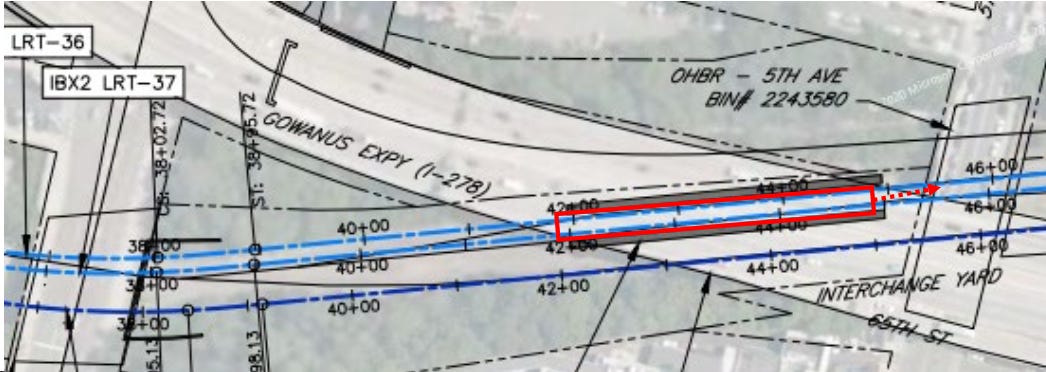
Comment 16. The IBX “4th Avenue” station in Brooklyn should be renamed the “5th Avenue” station and its entrance location should be properly indicated on maps. The latest publicly available plans show the “4th Avenue” station at the place shown by the red outline in the drawing below, with the station entrance apparently at 5th Avenue:[11]
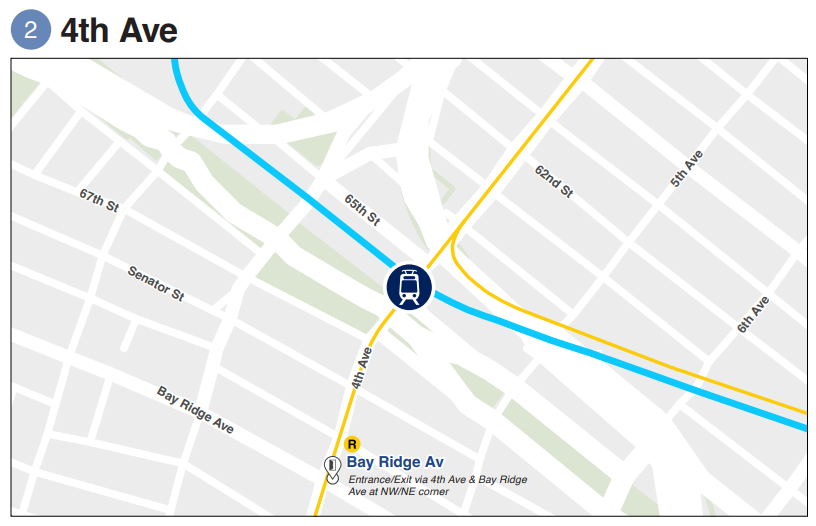
Maps indicating the “4th Avenue “station location, like the one below, should be corrected to avoid misleading riders into believing it provides direct access to the 4th Avenue subway and because the entrance will be at 5th Avenue.
Comment 17. The 8th Avenue station on the IBX line should be combined with the Sea Beach line station there, to provide rapid cross-platform transfers between lines, or at least escalators between platforms on these lines should be provided there. See Comment 7.
D. MODE and CHOICE OF RAILCARS
Comment 18. The choice of mode and railcars should be reevaluated in light of the almost doubling of MTA’s ridership predictions since January 2023 and even higher third party predictions.
The IBX Feasibility Study Interim Report in January 2023[12] predicted an IBX weekday ridership of 87,800 for the Light Rail Transit (LRT) mode. That mode was selected in the PEL Study report in January 2024.[13] That report estimated IBX weekday ridership would be 115,000 in 2045. In August 2025, Governor Hochul reported a weekday ridership prediction of 160,000. Others have predicted a higher weekday ridership of up to 254,000 trips. See Pegram, Interborough Express Ridership Predictions—Part 2.
Comment 19. Ridership predictions should be reevaluated to take full account of riders who transfer to or from a bus or subway at both ends of their IBX trip. MTA ridership predictions for the IBX line appear to have been based primarily upon trips to or from the Primary Study Area, which is within a half-mile of IBX corridor. See Interim Report, Appendix 1.5. Those predictions may have overlooked the likelihood that many IBX riders will not live or work within one half-mile of the IBX corridor. Rather, they will take a bus or subway to an IBX station, and another bus or subway from another IBX station.
Comment 20. IBX Railcars should be fully automated and driverless.[14] Many modern transit systems are fully automated and driverless—for example—the Montreal Réseau express métropolitain (REM) (“Metropolitan Express Network”) light metro system. See Pegram, Unattended Train Operation for the Interborough Express, and Wikipedia, List of driverless train systems.
The final Scoping Document also should explain that fully automated and driverless Light Metro is practically the same as the previously rejected “Automated Guideway Transit” (AGT) mode and that the reasons for the earlier decision to remove the AGT mode from consideration for the IBX line are no longer applicable.
Comment 21. IBX railcars should be of the high-floor type. Low-floor railcars are primarily intended for lower capacity, street-running and other ground-level lines. Low-floor railcars are less desirable than high-floor cars for several reasons.
The high-floor arrangement of a conventional railcar or high-floor Light Metro vehicle has considerable space under the car body for necessary equipment, such as an air compressor and air tank for the air brake system, air-conditioning compressor and condenser, electric air heater, batteries, and other auxiliary and main electrical power equipment. The space under low-floor railcars is limited. As a result, the trucks and equipment there are less accessible for maintenance, and some equipment must be placed elsewhere, such as between the car ceiling and roof, where panels must be removed for access. That would lead to increased maintenance expense. See Pegram, No Low-Floor Railcars for the Interborough Express
Low floor cars typically require trucks (bogies) that are less reliable than conventional subway-type trucks. See Pegram, No Low-Floor Railcars for the Interborough Express. The so-called 70% low-floor light rail cars, such as those used on the NJ Transit Hudson-Bergen Light Rail line also have stairs at each end of the car, reducing standing room and creating congestion in boarding and disembarking from the cars.
Comment 22. Rail cars should be provided with Multi-function couplers (MFCs), also known as fully automatic couplers, which make all connections between the rail vehicles (mechanical, air brake, and electrical) without human intervention. The IBX reports and the Draft Scoping Document anticipate that railcars will be coupled and uncoupled frequently, depending on capacity requirements at different times and for car-washing. See Comment 35 re car washing. See Wikipedia, Railway Coupling, at “Multi-function couplers.”
Comment 23. The IBX railcars should have wide doors and similar door-opening width per unit length as the proposed R262 NYC Transit, A Division subway cars.
Comment 24. The IBX railcars should have doors in the same position on each side to facilitate operation at either side of station central platforms that have platform screen doors.
Comment 25. IBX railcar capacity estimates and seat sizes should recognize the size of current riders and should not be based on NYC Transit loading guidelines, established when riders were smaller. There has been a general increase in the size of riders since current loading guidelines were established. Those changes and studies regarding proximity of riders and their comfort should be considered in IBX railcar planning. See Pegram, Railcar Capacity and Human Body Size and Knees, Feet and the Interborough Express.
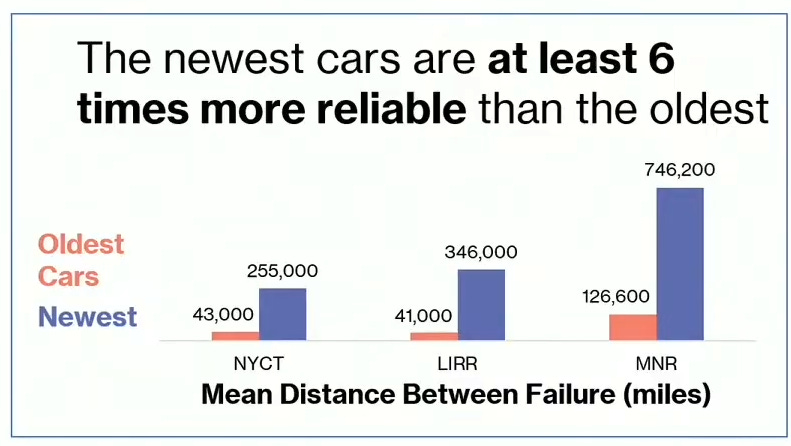
Comment 26. The IBX railcars should be no less reliable than the newer NYC subway car designs, which have exceptional reliability. For example, according to NYC Transit President Demetrius Crichlow, the new R211 railcars are five times as reliable as the R46 cars they are replacing.[15] Overall, the newest NYC Transit cars are approximately six times as reliable than the oldest, as indicated in a slide presented at June 23, 2025 MTA Board Capital Program Committee meeting (excerpt below).[16] Reliability appears to favor basing new railcars for the IBX line on the best NYC Transit subway car designs.
Comment 27. The MTA should reevaluate its prediction, in the PEL Study Report and the Draft Scoping Document, that “Light Rail vehicles can be procured “off-the-shelf” without modification. The MTA’s published reports and appendices do not contain information supporting the statements regarding greater availability of “off-the-shelf” Light Rail vehicles suitable for the IBX project. The final Scoping Document should require the EIS to evaluate how many manufacturers of “off-the-shelf’’ light railcars suitable for the IBX line have been qualified by the MTA, and satisfy the applicable “made in USA” and “made in New York” requirements.
Comment 28. The MTA should reevaluate its predictions, in the PEL Study Report and the Draft Scoping Document, concerning the pool of rolling stock manufacturers in the United States.[17] For example, circumstances are likely to be different when the IBX railcars are ordered from when the PEL Study Report was written. It may be possible to order highly reliable “A” Division type railcars with pantographs with a subway car order, at a lower per-rider cost than purchasing Light Rail vehicles. Consider whether the manufacturers for each car type are qualified by the MTA or could become qualified promptly. For example, the MTA rolling stock program manager stated at a June 23, 2025 MTA Board Capital Programs Committee meeting that two transit car manufacturers are now qualified by the MTA and that two more are in the process of being qualified.[18] How many manufacturers of “off-the-shelf’’ light railcars suitable for the IBX line are there who have been qualified by the MTA, and can satisfy the applicable “made in USA” and “made in New York” requirements? (The Reddit r/nycrail string here identifies at least some potential manufacturers).
Comment 29. The EIS should revive consideration of “Heavy Rail” (“A” Division subway-type) and “Automated Guideway Transit” (like JFK AirTrain) alternatives. The New York State Environmental Quality Review (SEQR) regulations require evaluation of “all reasonable alternatives.”[19] The best reasonable alternatives are Heavy Rail (similar to NYC Transit A Division subway cars) and Automated Guideway Transit. The reasons for removing those modes from consideration at the Feasibility Study stage no longer appear to be applicable based on later studies for Light Rail vehicles of similar width. The MTA’s greatly increased ridership predictions also suggest consideration of railcars designed for heavy duty.
Comment 30. NYC Transit “A” Division type railcars with pantographs should at least be included as an option in the next MTA RFP for “A” Division railcars. That would permit comparison of cost, expected reliability and features with that of any other railcars being considered for the IBX line. See Pegram, Railcars for New York City Transit, Subway-Type Railcars for the Interborough Express, NYC Transit “Rail Fleet Asset Management Plan” and Full-Size Trains for the Interborough Express.
Comment 31. Because there are no significant environmental differences between use of Light Metro, NYC Transit A-Division type subway and Automated Guideway Transit railcars on the proposed IBX alignment, all three of these railcar types can and should be considered through the IBX scoping and EIS stages.
Comment 32. The final Scoping Document should specify that the Environmental Impact Statement (EIS) shall provide capital, operating and maintenance cost comparisons between fully automated, zero-person train operation (ZPTO), one-person train operation and two-person train operation (TPTO) in each of the LRT mode, an A-Division subway Heavy Rail mode and an Automated Guideway mode.
Comment 33. The MTA should stop referring to the currently preferred mode for the IBX line as “Light Rail.” That implies street-running for at least part of the line, and small or moderate ridership. If the MTA ultimately decides not to use subway-type Heavy Rail railcars on the IBX line, the proper term would be “Light Metro.” The adoption of this term should be explained in the final Scoping Document.
E. TRACTION POWER
Comment 34. Use of 1,200 or 1,500 volt DC traction power should be considered, instead of the currently planned 600 or 750 volt DC power. That would be more efficient and probably would require only about half of the number of Traction Power Sub-Stations currently planned. Use of such a higher voltage for traction power is not unusual. The Montreal REM system, for example, uses 1,500 DC catenary power.[20] The reduction in number of sub-stations might permit a reduction in the number of property-takings outside the right-of-way currently owned by the LIRR or CSX. There should be no significant railcar cost difference.
F. OPERATIONS FACILITY AND STORAGE YARD
Comment 35. The size of the automatic exterior wash system in the Operations Facility and Storage Yard (OFSY) should be reconsidered. At page 17, the Draft Scoping Document envisions the possibility of “trainsets up to 325 ft. long”; however, it says “trains may be separated to run through the automatic exterior wash system independently.” Separating railcars for washing appears to be inefficient and time-consuming. The work-rules and operating costs of separating and recoupling for washing should also be considered.
G. TRANSPARENCY
In this part, I urge greater accuracy and transparency about the IBX project in MTA communications with the public, including the final Scoping Document, and the draft and final EIS.
Comment 36. The final Scoping Document, EIS and information published about the IBX proposal should only discus railcar suitability in light of the latest studies and plans, and should not suggest that the reasons given in the past for eliminating some railcar modes from consideration in the IBX project are applicable now. While statements in the Draft Scoping Document about past mode choice decisions may be historically correct, they are misleading and should be corrected or omitted. The historic reasons for not selecting Heavy Rail or Automated Guideway Transit—most or all of which are no longer valid—are practically irrelevant at this time. I have not found any requirement in the SEQR regulations for discussion in the Scoping Document of past actions that led to exclusion of certain modes from consideration. The regulations do require that the Scoping Document consider all reasonable alternatives. See Comment 29. In my opinion, reasonable alternatives include NYC Transit A-Division-type Heavy Rail and Automated Guideway Transit modes, which should not be denigrated in the Scoping Document unless justified by present circumstances and knowledge.
Rather than the present, detailed historical statement, the Scoping Document could include a general statement that certain modes were excluded from consideration in the Feasibility and PEL studies under understandings of what alternatives were viable at that time; however, the reasons for exclusion of NYC Transit A-Division-type Heavy Rail and Automated Guideway Transit modes may no longer be applicable. See Comment 32.
Comment 37. The Scoping Document should not suggest that street-running in the Metropolitan Avenue area is a viable alternative for the IBX line.
The Draft Scoping Document states at page 10:
“As with all project modes assessed in the PEL Study, LRT could not operate within the existing freight tunnel below Metropolitan Avenue. However, the flexibility of LRT allows it to run in a variety of operating environments, and limited on-street operations along Metropolitan Avenue, 69th Street and 69th Place were determined to be a feasible alternative to constructing a new, adjacent tunnel below Metropolitan Avenue. As conceptual design was advanced beyond the PEL Study, additional tunneling solutions for LRT were developed that represent a more cost-effective alternative to those contemplated in previous planning studies. As discussed elsewhere in this Scoping Document, tunneling at Metropolitan Avenue will be evaluated further in the EIS.”
The suggestions in the Draft Scoping Document that street-running is still a viable alternative under real consideration is inconsistent with MTA statements and with Governor Hochul’s press release on August 1, 2025. For example, the August 1, 2025 press release by Governor Hochul stated, “In Middle Village, Queens, the MTA is progressing with the design of a tunnel solution beneath Metropolitan Avenue, rather than on-street operations, making the proposed line less prone to travel delays due to mixed traffic operations.” On September 29, 2025 the IBX Project Executive for the IBX project told the MTA Board Capital Committee “We’ve removed street-running from the alignment and are advancing the design of a tunnel solution under Metropolitan Avenue.” (See slide from that meeting, below).[21]
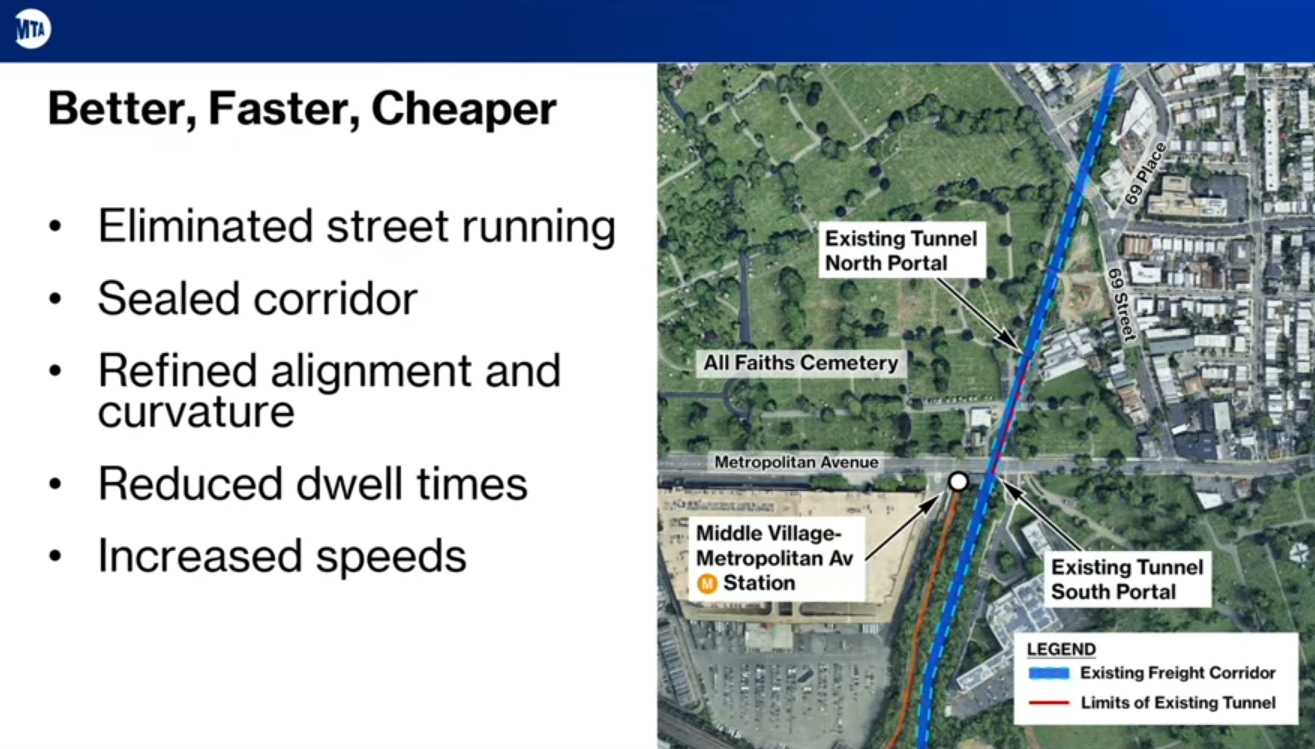
Both the Governor’s press release and the MTA presentation credited the elimination of street-running for the projected reduction in running time and increased ridership. The press release said that the tunnel solution “has reduced projected running times of the new line from 39 minutes to 32 minutes and has increased ridership projections to 160,000 per day, up 50,000 from the MTA’s prior estimate.” The MTA presentation said, “This refinement has reduced projected running times of the new line from 39 minutes to 32 minutes and has increased ridership projections to 160,000 per day, up 50,000 from the MTA’s prior estimate.” See slide from that presentation below, juxtaposing the runtime and ridership projections with a map of the Metropolitan Avenue tunnel proposal.
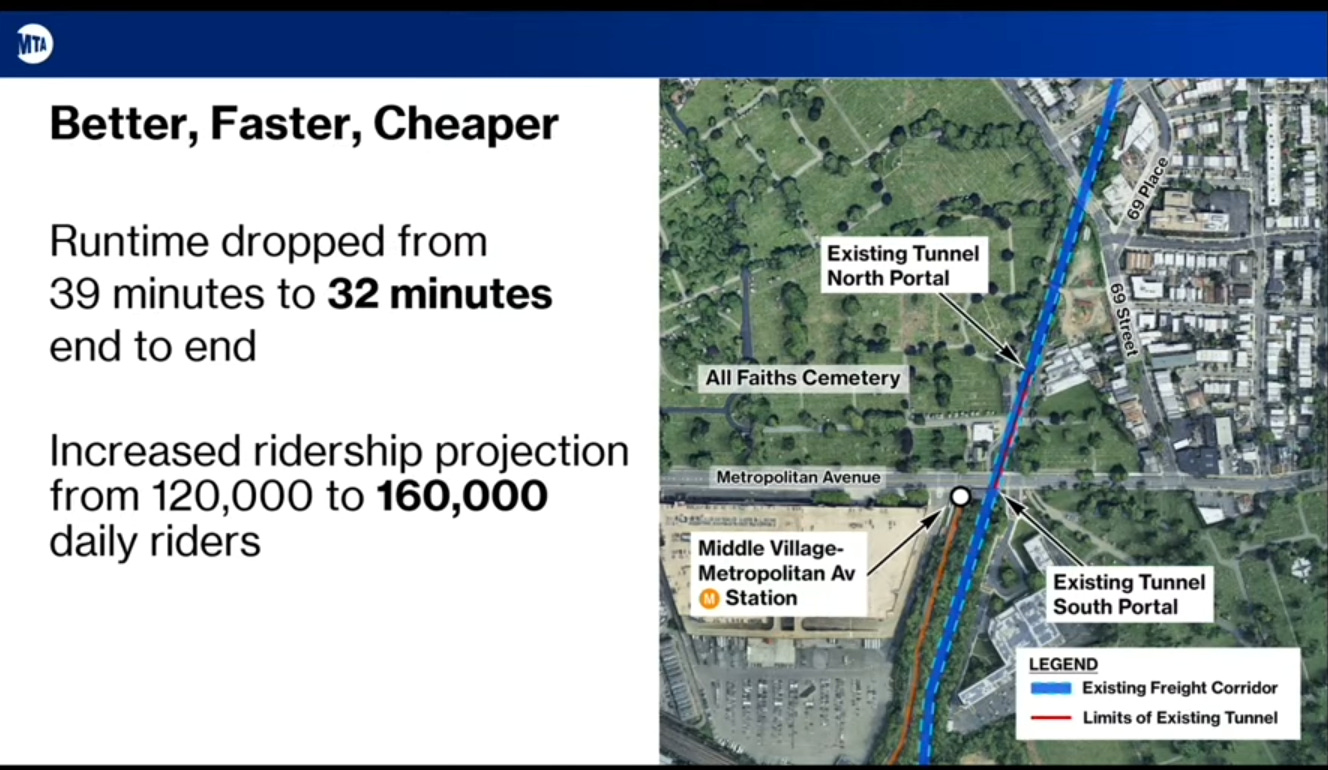
If the Scoping Document is to suggest that street-running is still under real consideration, the document should make it clear that the projected 32 minute running time and ridership projection of 160,000 trips per day are not applicable to street-running, and that street-running is not likely to be accepted by the public.
Comment 38. The Scoping Document should make it clear that the NYC A-Division subway-type Heavy Rail and Automated Guideway Transit modes could use the proposed, 520 foot Metropolitan Avenue Tunnel.
Comment 39. The Scoping Document should make it clear that, if the NYC A-Division subway-type Heavy Rail, Automated Guideway Transit and Commuter Rail modes used the proposed, 520 foot Metropolitan Avenue Tunnel and the same type of stations as presently proposed for` the Light Rail mode, the previously perceived, relatively high construction costs, high complexity and risks of those modes would not be applicable.
Comment 40. The Scoping Document should not suggest that the Construction Capital Costs for Heavy Rail, Automated Guideway and Commuter Rail modes would be greater than the currently preferred LRT mode.
The Draft Scoping Document suggests that Construction Capital Costs for the LRT would be significantly that for the Heavy Rail, Automated Guideway and Commuter Rail modes. Those other modes were removed from consideration when the Light Rail mode was to include street-running around the All Faiths Cemetery at Metropolitan Avenue. The principal reasons for the prediction of higher costs for those other modes was the cost of an approximately 5,000-foot long tunnel from Cypress Hills to Elliot Avenue,[22] as compared with street-running LRT, and the higher costs of stations for the Conventional Rail mode.[23]
There does not appear to be any reason why the approximately 520-foot long tunnel now being considered as an option for the LRT mode could not be used for NYC Transit A-Division subway cars, similar-sized Commuter Rail cars or Automated Guideway cars. (Note that the Draft Scoping Document acknowledges, at pages 14 and 16, that the cost of an approximately 520-foot long tunnel now being considered as an option for the LRT mode would “Slightly higher than Baseline (street running)”). Nor does there appear to be any reason why the station costs for those modes should be significantly different from Light Metro stations. See Comment 12.
Comment 41. The Scoping Document should not suggest that the Right-of-Way (ROW) requirements for Heavy Rail and Automated Guideway modes would be significantly different from ROW requirements for the currently preferred LRT mode.
The Draft Scoping Document states that “Heavy Rail Transit and Automated Guideway Transit were removed from the list of alternatives in the Feasibility Study due to … inability to effectively utilize available ROW or minimize additional ROW needed. As both modes require physical separation from freight operations, greater space needs increase the extent and complexity of reconstruction within the corridor, thus increasing the potential for impacts along portions of the corridor.” In fact, now that the LRT mode no longer includes any street-running, the ROW requirements for the LRT mode and the NYC A-Division subway-type Heavy Rail and Automated Guideway Transit modes appear to be substantially the same.
Comment 42. The Scoping Document should not suggest that the cost of railcars for the Light Metro mode would be less than suitable railcars for other modes. Such a suggestion is not properly supported and circumstances concerning railcar costs are likely to change.
The Draft Scoping Document states at pages 9-10: “CR was found in the PEL Study to have a significantly higher capital cost of vehicle procurement” (as compared with Light Rail vehicles. The detailed information in the Detailed Cost Report in Appendix 1.11 of that report predicts that 72 LRVs would be required at a cost of $6 million each, for a total cost of $432 million.[24] That report said that 100 Conventional Railcars would be needed at a cost of about 4.85 million each, for a total cost of about $485 million,[25] 12% greater than the predicted LRV cost. However, the basis for the Conventional Railcar cost prediction—in terms of which railcar design and the quantity ordered—is unclear. A better comparison would be based on including IBX railcars in orders or order-options for NYC Transit A-Division subway cars. That cost appears to be about than $3 million per railcar, in which case adding 100 A-Division type railcars for the IBX probably could cost about $300 million, at least 30% less than the cost of LRVs predicted in the PEL Report. See Pegram, Subway-Type Railcars for the Interborough Express, Railcars for New York City Transit
Comment 43. If existing law, a potential law, a regulation or work rules concerning NYC Transit subway operators and conductors are affecting the choices of mode and railcars for the IBX line, as appears may be the case, the MTA disclose that—in detail--to the public and government officials. See Pegram, A Non-Technical Reason Suggests Light Rail for the Interborough Express and Preserving Jobs for NYC Transit Conductors While Improving Transit Service.
This article expresses the personal views of the author and does not express the views of his employer, or any client or organization. The author has degrees in law and physics, and has taken several engineering courses. After five years of work as an engineer, he has practiced law primarily in the field of patents for over 50 years, dealing with a wide variety of technologies. He is a life-long railfan and user of public transportation in the United States, Europe and Japan.
[1] © John Pegram, 2025.
[2] See Implementation of Rapid Transit Loading Guidelines (2017) and Rapid Transit Loading Guidelines (1988).
[3] MTA, Interborough Express – Feasibility Study and Alternatives Analysis – Interim Report (Jan. 2022) (Interim Report). The report without appendices is available from the MTA here. The most complete version with appendices available to the public, produced to me in response to my Freedom of Information Law (FOIL) request, is available for download here. Citations to pages of this version, as indicated by a PDF reader, are in the form [###/1041].
[4] MTA, Interborough Express Planning & Environmental Linkages Study (Jan. 2023) (PEL Report), is available from the MTA here. The most complete version available to the public, including all appendices, was produced to me by the MTA in response to my Freedom of Information Law (FOIL) request and is available for download here. Citations to pages of that version, as indicated by a PDF reader, are in the form [###/1150].
[5] https://www.governor.ny.gov/news/governor-hochul-announces-interborough-express-advancing-planning-active-phase
[7] Interim Report, supra note 3, Appendix 1.16, p. 9 [754/1041]. See also id. at pp. 6-7 & 13 [696-697, 758/1041].
[8] See slide reproduced above and text at notes 5 & 6 supra.
[9] See, e.g., Interim Report, supra note 3, Appendix 1.17 at p. 11 [782/1041].
[10] Interim Report, supra note 3, Appendix 1.17 at p. 11 [782/1041].
[11] Map from MTA, FTA Project Review, slide 34 (April 24, 2024). See Pegram, Interborough Express—FTA Project Review.
[12] Supra, note 3.
[13] Supra, note 4.
[14] Per the GoA4 standard. This is also called unattended train operation (UTO) or zero person train operation (ZPTO).
[15] MTA NYC Transit/Bus Committee Meeting, December 16, 2024 video at ~0:47:30.
[16] MTA Board Capital Program Committee video at ~48:40.
[17] PEL Study Report at p. 29.
[18] MTA Board - Capital Program Committee Meeting video at ~ 53:20.
[19] See generally 6 NYCRR Part 617, especially 6 NYCRR § 617.8(e)(5), which requires that the Scoping Document should include: “the reasonable alternatives to be considered,” and § 6 NYCRR 617.9(b)(1), which requires: “An EIS must … evaluate all reasonable alternatives.”
[20] Wikipedia, Réseau express métropolitain.
[21] Capital Program Committee video at 1:09.
[22] PEL Study Report, Appendix 1.16, Conventional Rail Track Plan sheets 22-24 [1115-17/1150].
[23] See note 12, supra.
[24] PEL Report, supra note 4, Appendix A of Appendix 1.11, at p. 7 [816/1150].
[25] Id. at p. 9 [818/1150].