
Interborough Express: The Winning Design Proposal
John B. Pegram[1]
This is one of a series of articles introducing documents obtained from the MTA in response to Freedom of Information Law requests.
The joint venture Jacobs + HDR[2] submitted the winning proposal and has begun providing Interborough Express (IBX) general engineering consultant services under contract CS00037C with the MTA.[3]
According to the October 2024 Request for Proposals, which led to this proposal, “The first phase (“Civil Phase”) will prepare the corridor to receive the light rail system and includes demolition of existing structures; utility relocation; streetwork; environmental remediation; rehabilitation of existing, and construction of new, above-grade and undergrade bridges; construction of new tunnel structures and retaining walls; and repositioning of freight infrastructure. The second phase (“Light Rail Phase”) will complete the design and installation of the light rail system and incudes construction and installation of passenger trackwork, stations, a light-rail vehicle storage yard, an operations center, traction power, signals and other systems; procurement of light rail rolling stock; testing and commissioning; and all other work required to place the light rail system into revenue service.”[4]
The contract with Jacobs + HDR included both phases.
The Jacobs + HDR technical proposal is impressive.[5] It shows an excellent understanding of the project and proposes what appears to be an appropriate team. Both Jacobs and HDR have a strong presence in New York City and relevant experience in working on MTA projects.
This article touches on a few high points identified in my first reading of the redacted technical proposal.
Corridor-wide Issues
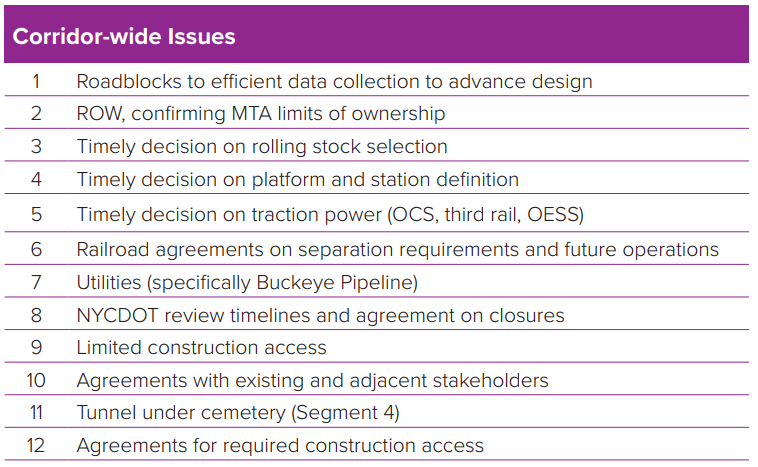
Jacobs + HDR identified a number of Corridor-wide issues, as follows:
Design and Construction in the IBX Corridor
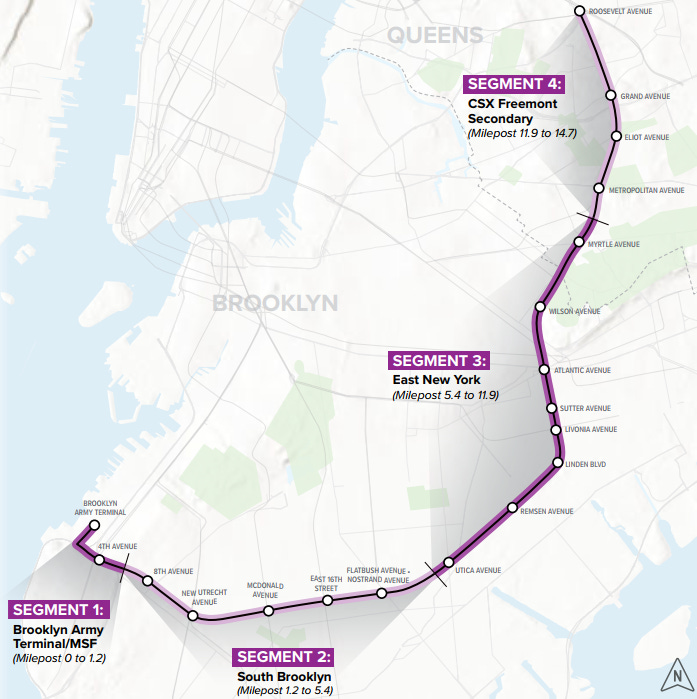
Because of the size of the project and the different dominant issues in different areas, Jacobs + HDR proposed a segmented design approach, with a team for each of four IBX corridor segments. The segments are identified in the map below:
The proposal made several suggestions for replacement of the many bridges along the IBX corridor. It also pointed out the limited access existing in some sections of the corridor and the need for access during construction.
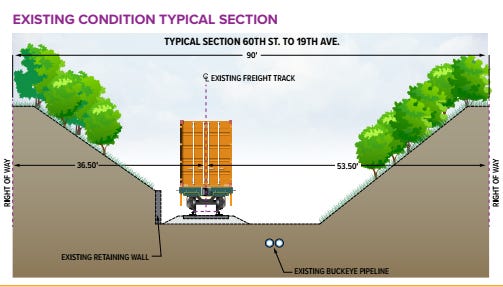
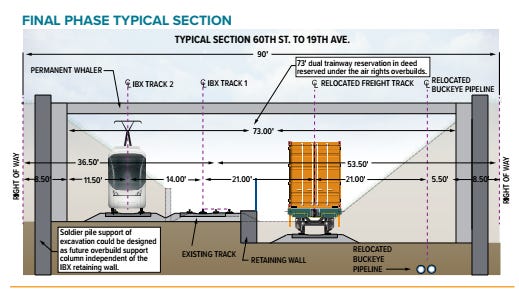
A considerable amount of excavation will be required in narrower portions of the corridor in Segment 2, as illustrated by the before and after drawings below. New retaining walls and “whalers” across the right-of-way are proposed to provide the necessary, widened corridor. Freight and transit tracks would be at different levels, to provide adequate clearance for freight trains and to achieve necessary separation. The Buckeye Pipeline would be moved to locations where it would be accessible.
Avoiding Freight-Transit Track Crossings
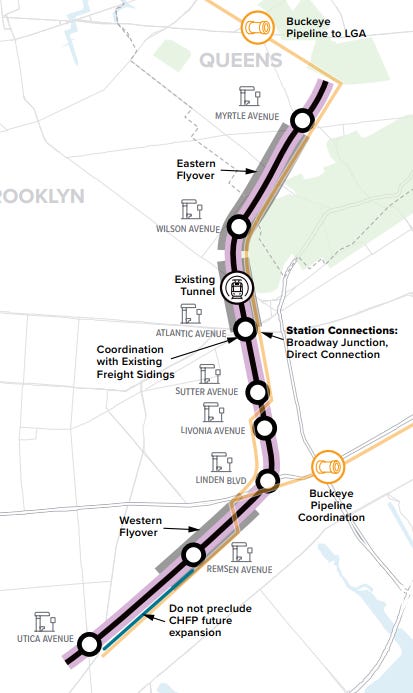
For most of the corridor, the transit tracks will be on the Northwest side and the freight tracks will be on the Southeast side. That will permit the freight tracks to connect with the freight yard and carfloat at Bay Ridge, and the freight yard and LIRR main line at Fresh Pond, without crossing the transit tracks. However, the freight tracks must also serve customers on the Northwest side of the line between Linden Boulevard and Atlantic Avenue. Therefore, the MTA proposed “flyovers” for the transit tracks to cross above the freight tracks. Jacobs + HDR proposed modification of the plan, placing the flyovers at the locations indicated in the map below:
Rail Vehicles
The proposal said only a little bit about rail vehicles, saying, “The rail vehicle design will be expected to provide full train length accessibility with level boarding and consistent floor height across all cars. …. [W]e’ll conduct carbuilder outreach and review vehicle industry reports to assess high- and low-level boarding, speed, length, and capacity. These factors will influence train size, platform length, and fleet size. For example, the conceptual plan targets 200 peak passengers per car. With current ridership forecasts, two-car trains at four-minute headways or three-car trains with longer headways would both meet peak demand.” Nothing was said about automation of the rail vehicles. In my opinion, the IBX line should be fully automated and driverless.[6]
The ridership figures used in the proposal appeared to have been based on the January 2023 Planning and Environmental Linkages Study Report’s (PEL Report) estimate of 115,000 weekday riders.[7] However, the latest MTA projection, in August 2025, was 39% greater, “about 160,000 riders a day.”[8]
In my opinion, the train sizes and frequency should be reevaluated in light of the ever-increasing ridership projections and the railcar capacity target of 200 passengers per car should be reevaluated in light of rider comfort issues.[9]

[1] © John Pegram, 2026.
[2] Jacobs + HDR JV is a joint venture of Jacobs Civil Consultants Inc. and Henningson, Durham & Richardson Architecture and Engineering, P.C.
[3] The contract is discussed in my article Another Step Towards Building the Interborough Express.
[4] Request for Proposal Consultant Services, Contract No: CS00037C - Interborough Express Light Rail Project General Engineering Consultant Services at page 8. (Copy attached to the article cited in note 3, supra.
[5] My comments are based on the attached, redacted copy of the technical proposal. I am seeking a copy of the full proposal, without redactions.
[6] See Pegram, Unattended Train Operation for the Interborough Express.
[7] Not an error by Jacobs + HDR. Bidders were directed by the RFP to refer to the PEL Report, among other references.
[8] Hochul announcement, August 1, 2025, rough transcript, available at https://www.governor.ny.gov/news/video-audio-photos-rush-transcript-governor-hochul-announces-interborough-express-advancing. See also Comments 18-19 in Pegram Comments on IBX Draft Scoping Document hereinafter “Comments”).
[9] See Comments 18, 19 & 25 in Comments, supra note 8. See also Pegram, Knees, Feet and the Interborough Express and Rider Capacity and Human Body Size.
About a year ago, at an IBX town hall, I spoke with one of the MTA IBX team. I suggested automated metro, saying we already had a successful one in NYC. "You mean the AirTrain?" he said. I understood that would be considered. But it is probably very sensitive, because of union issues and proposals to require conductors on all NYC Transit subways.
Note that an automated train was one idea considered initially and rejected, but for reasons--such as the then-perceived need for street-running--that are no longer relevant, in my opinion.
Nothing is set in stone, ever. But, the IBX project has around 50% funding approved by NY State in the MTA Capital Plan and engineering design is proceeding for some form of "light rail." Full automation is possible and appears to be under consideration. Stay tuned.